Open-source research framework

Trading Agents: Multi-Agent LLM Financial Trading Framework

Deploy a full AI trading team — analysts, bull/bear researchers, trader, risk manager, and portfolio manager — to collaboratively evaluate any ticker, debate strategies, and produce auditable trading decisions. All open source.

Run the CLI
tradingagents analyze --ticker NVDA --date 2026-01-15 --checkpoint
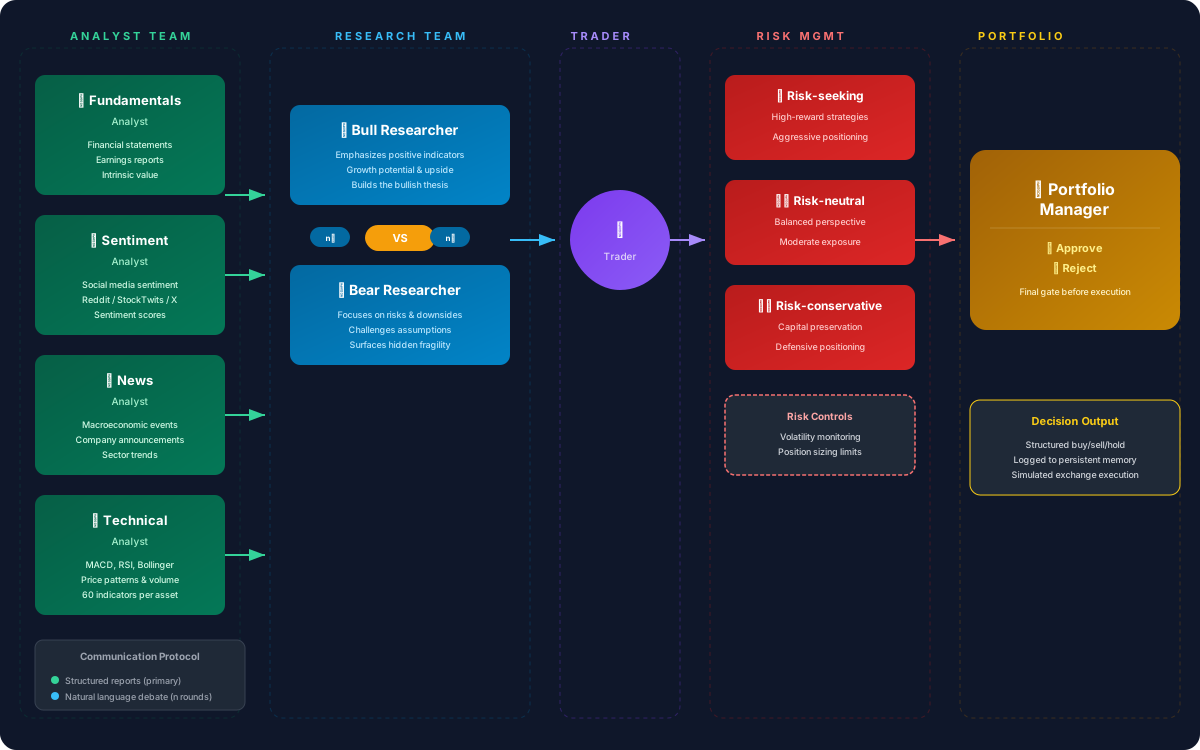
TradingAgents multi-agent architecture diagram showing five stages: Analyst Team, Research Team, Trader, Risk Management, and Portfolio Manager
4

analyst lenses in one run

2

research sides in structured debate

1

persistent decision memory per ticker

Global

markets through Yahoo Finance tickers

What Are Trading Agents? A Multi-Agent LLM Trading Framework

TradingAgents is an open-source framework that replaces a single model with a team of specialized LLM agents — each with a focused role, connected by LangGraph, and coordinated through structured debate and multi-layer risk review.

1

Multi-Agent Architecture

Instead of asking one model to do everything, TradingAgents assigns narrow roles to specialized agents: four analysts (fundamentals, sentiment, news, technical), two researchers (bull/bear), a trader, a risk manager, and a portfolio manager. Each agent is powered by an LLM and connected through a LangGraph state machine that tracks every decision step.

2

Debate-Driven Decision Making

Before any trade is proposed, bull and bear researchers engage in structured multi-round debates, cross-examining evidence from the analyst team. This adversarial process reduces single-model hallucination, surfaces blind spots on both sides, and produces conclusions that are more balanced than any one model could achieve alone.

3

Risk-First Execution Pipeline

Every trade proposal passes through a dedicated risk management agent that evaluates volatility, liquidity, and portfolio exposure — then through a portfolio manager with final approval authority. No simulated execution happens without passing both gates.

4

Global Market Coverage

TradingAgents works with any Yahoo Finance ticker: US equities (AAPL, SPY), Hong Kong (0700.HK), Japan (7203.T), London (AZN.L), India (RELIANCE.NS), China A-shares (600519.SS), and crypto pairs (BTC-USD, ETH-USD). Company identity resolves deterministically before any analysis begins.

TradingAgents Multi-Agent Architecture: 9 Specialized Roles

TradingAgents mirrors a real trading firm. Instead of asking one model to do everything, it assigns narrow, auditable roles to nine specialized agents organized across three layers — analysts, researchers, and execution.

Analyst team — four research lenses

Fundamentals analyst

Evaluates financial statements, earnings quality, and intrinsic value signals. Flags red flags in revenue recognition, margin trends, and balance sheet health.

Sentiment analyst

Aggregates news tone, StockTwits sentiment, and Reddit discussion into a short-horizon market mood indicator. Surfaces crowd psychology that fundamentals alone miss.

News analyst

Monitors global macroeconomic indicators and market-moving headlines. Interprets how regulatory changes, earnings surprises, and geopolitical events affect the ticker.

Technical analyst

Applies indicators such as MACD, RSI, and moving averages to detect patterns and forecast price direction. All claims are grounded in a verified data snapshot.

Decision chain — debate, execute, approve

Step 1

Bull researcher

Builds the upside case from analyst findings. Pressure-tests where conviction should increase and what catalysts could drive further gains.

Step 2

Bear researcher

Builds the downside case. Surfaces hidden fragility, valuation risks, and scenarios where the bull case breaks down.

Step 3

Trader

Synthesizes research and debate outcomes into a structured action proposal with recommended position, timing, and rationale.

Step 4

Risk management

Re-evaluates the proposal through volatility, liquidity, and portfolio exposure lenses. Can reject or request modifications before escalation.

Step 5

Portfolio manager

Makes the final approve-or-reject decision. Approved proposals are sent to the simulated exchange; all decisions are logged for audit.

Trading Agents Resources: GitHub, Paper, and Quick Start

Three entry points into the project — choose the one that matches how you prefer to explore a new research framework.

GitHub repository

Clone, install, and run. Includes CLI commands, environment setup, provider configuration, and release tags.

  • CLI, Python package, and Docker quick-start paths
  • Release notes with recent grounded-data improvements
  • Issues, stars, forks, and community contributions
Open repository

Trading-R1 technical report

Read the research paper for system architecture, role design, and evaluation methodology before diving into code.

  • Research motivation behind the agent-firm structure
  • Role definitions and multi-stage reasoning flow
  • Experimental results and performance benchmarks
Read report

Framework overview

Stay on this page for a dense walkthrough of the architecture, workflow, and key design decisions.

  • Framework summary, architecture, and workflow
  • Comparison against simpler agent setups
  • Quick orientation before deeper documentation
Browse sections

Decision flow

Trading Agents Workflow: From Ticker to Portfolio Decision

Every stage has a narrow job and passes a structured artifact to the next stage. The result is a decision path you can audit, resume, and compare across runs.

1

1. Ingest the trading context

Choose ticker, date, LLM provider, model pair, and research depth — all configurable from the CLI or a Python config object.

2

2. Build the analyst record

Four specialist analysts independently collect fundamentals, sentiment, news, and technical context using market-aware ticker resolution and verified data snapshots.

3

3. Run bull and bear debate

Both researchers challenge the analyst findings from opposing sides. Multiple debate rounds surface evidence gaps before any trade is proposed.

4

4. Produce a trader proposal

The trader synthesizes research and debate into a structured recommendation: action, position size, timing, and supporting rationale.

5

5. Risk review and portfolio approval

Risk management evaluates volatility and exposure. The portfolio manager approves or rejects. Approved proposals execute against the simulated exchange and are written to persistent memory.

Why the output is easier to trust

Verified data-access contracts reduce fabricated market claims.

Grounded analysts and deterministic ticker resolution tighten factual drift.

Checkpointed LangGraph runs resume from the last successful step — no restarts.

TradingAgents Capabilities: Providers, Markets, and Persistence

The framework stays flexible where experimentation matters and disciplined where factual accuracy is critical.

Grounded data contracts

Agents cite verified data snapshots rather than loosely inferred price levels. Ticker identity is resolved deterministically before any analysis begins.

  • Verified ticker identity before agents start
  • Grounded sentiment analyst with structured data sources
  • Price and indicator claims anchored to a verified snapshot

Multi-provider LLM support

Use frontier APIs, local models, or any OpenAI-compatible endpoint — no graph changes required.

  • OpenAI, Anthropic Claude, Google Gemini, xAI Grok, DeepSeek
  • OpenRouter, Ollama, remote Ollama, Groq, Kimi, Mistral, Bedrock
  • vLLM, LM Studio, llama.cpp, and custom OpenAI-compatible backends

Global market access

Any Yahoo Finance market works with exchange-suffixed tickers. The same workflow spans equities, ADRs, and crypto.

  • US: AAPL, SPY · Hong Kong: 0700.HK · Japan: 7203.T
  • London: AZN.L · India: RELIANCE.NS · China: 600519.SS
  • Crypto: BTC-USD, ETH-USD and all Yahoo Finance pairs

Persistent decision memory

Two state layers keep long-running research sessions usable instead of disposable.

  • Decision memory appends to ~/.tradingagents/memory/trading_memory.md
  • Per-ticker SQLite checkpoints for crash recovery
  • Automatic checkpoint cleanup after successful completion

Reproducibility boundaries

The project is explicit about what varies between runs so researchers can separate signal from noise.

  • Reasoning-model outputs remain inherently non-deterministic
  • News and social sentiment drift over time even with pinned dates
  • Lower temperature narrows variation only on models that honor it

Trading Agents Scope: Inputs, Outputs, and Boundaries

Think of TradingAgents as a constrained research pipeline: clearly defined inputs flow through observable intermediate states to structured outputs, with explicit limits on reproducibility.

What you configure (inputs)

Ticker + market identity

A symbol with optional exchange suffix (e.g., 0700.HK, 600519.SS) plus a target trade date anchor the entire run.

LLM provider + model pair

Swap between frontier APIs, local Ollama models, or any OpenAI-compatible backend without touching the workflow graph.

Debate rounds + checkpoint toggle

More debate rounds yield deeper cross-examination at the cost of runtime. Checkpoint mode protects partially completed work from crashes.

What you get (outputs)

Multi-lens analyst record

Fundamental, sentiment, news, and technical findings compiled into a structured evidence base — not a single opinion.

Structured trading proposal

The trader emits a specific action (buy, sell, hold, pass) with position size, timing, and rationale instead of a vague market narrative.

Persistent decision history

Completed runs write to a decision log for cross-session learning. Per-ticker checkpoints let you resume interrupted runs from the last successful node.

Trading Agents Experimental Results and Backtest Performance

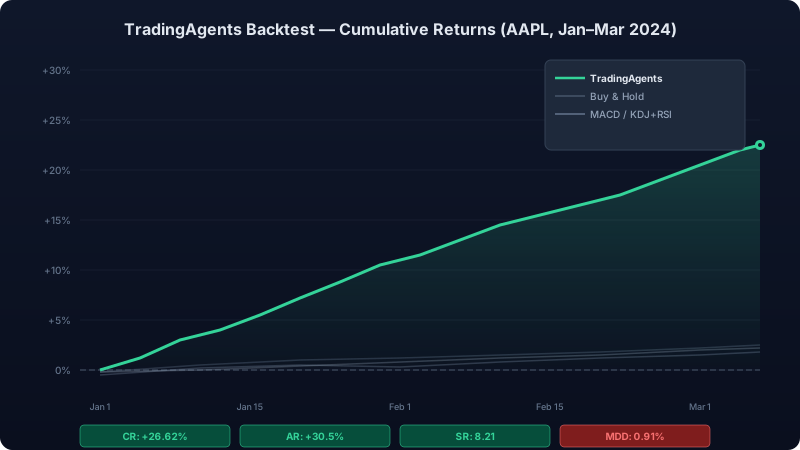
We evaluated TradingAgents using a comprehensive backtesting simulation from January 1 to March 29, 2024, across major technology stocks including Apple (AAPL), Nvidia (NVDA), Microsoft (MSFT), Meta (META), and Google (GOOGL). Agents made decisions based solely on data available up to each trading day, eliminating look-ahead bias. The multi-modal dataset integrated historical stock prices, news articles, social media sentiment, insider transactions, financial statements, and 60 technical indicators per asset.

TradingAgents backtest cumulative returns chart showing performance against Buy and Hold, MACD, and KDJ+RSI baselines for AAPL stock from January to March 2024

Experimental Setup

  • Backtest period: January 1, 2024 — March 29, 2024 (3 months)
  • Assets: AAPL, NVDA, MSFT, META, GOOGL (major technology stocks)
  • Data sources: Historical prices, news (Bloomberg, Yahoo, FinnHub, Reddit), social media (Reddit, X/Twitter), insider transactions (SEDI), financial statements, 60 technical indicators per asset
  • Baselines compared: Buy and Hold, MACD, KDJ+RSI, ZMR, and SMA (5 established strategies)
  • No look-ahead bias: agents only used data available up to each trading day
  • Evaluation metrics: Cumulative Return (CR), Annualized Return (AR), Sharpe Ratio (SR), Maximum Drawdown (MDD)

Key Results

  • TradingAgents achieved at least 23.21% cumulative return across all tested stocks, outperforming the best baseline by 6.1% on average.
  • On AAPL — a particularly challenging volatile market — TradingAgents delivered over 26% cumulative return within three months while traditional methods struggled to generalize.
  • Sharpe Ratio results demonstrate exceptional risk-adjusted returns, surpassing all baseline models including Buy-and-Hold and rule-based strategies consistently.
  • Maximum drawdown remained below 2.11% across all assets, demonstrating effective risk control through multi-agent debate and risk management oversight.
  • The LLM-based framework offers full explainability: every decision includes detailed reasoning, tool usage, and thought processes via the ReAct prompting framework, enabling traders to understand and debug the system.

Results depend on model choice, temperature, data quality, and time window. For research demonstration only — not investment advice. Past performance does not guarantee future results.

Build and run

Three Ways to Run TradingAgents

Start from the CLI for interactive exploration, use the Python package for scripted experiments, or run in Docker for an isolated environment.

CLI

Best for interactive runs and quick provider or model switching. Launch the TUI and configure everything from one screen.

git clone https://github.com/TauricResearch/TradingAgents.git
cd TradingAgents && pip install .
tradingagents

Python package

Best for scripted experiments and integrating the multi-agent graph into a broader research pipeline.

from tradingagents.graph.trading_graph import TradingAgentsGraph
ta = TradingAgentsGraph(debug=True)
_, decision = ta.propagate("NVDA", "2026-01-15")

Docker + local models

Best for isolated environments, team sharing, and Ollama-backed local inference without dependency conflicts.

cp .env.example .env
docker compose run --rm tradingagents
docker compose --profile ollama run --rm tradingagents-ollama

Trading Agents vs Trading-R1 vs Single-Agent Bots

TradingAgents occupies a specific space between academic research and simple bot wrappers. This comparison shows how it differs from both.

DimensionTradingAgentsTrading-R1 paperSingle-agent bot
What it isRunnable open-source framework with CLI, Python API, Docker, and a LangGraph workflow graph.Research paper describing system architecture, role design, and evaluation methodology.Typically a prompt wrapper around one LLM with no structured process.
Decision processMulti-stage pipeline: four analysts → bull/bear debate → trader → risk review → portfolio approval.Explains and motivates the multi-agent reasoning approach but is not itself executable.Single model produces a recommendation with no internal debate or adversarial review.
AuditabilityLangGraph state tracking, checkpoint resume, persistent decision log, and narrow role outputs.Useful for conceptual understanding of audit principles but no executable audit trail.Hard to inspect because all reasoning is compressed into one opaque model response.
Flexibility10+ LLM providers, local models, global tickers, Docker, and configurable debate depth.Not an operational tool; supports framework interpretation and research context.Often locked to one model, one market, or one API with minimal configuration options.
The paper and the framework are complementary. Trading-R1 explains the why; TradingAgents is where you run the workflow.

Trading Agents Release Timeline and Version History

Recent versions focused on making the framework more grounded, more resumable, and easier to run across providers and regions.

2026-06

v0.3.0

Verified data-access contract, expanded provider registry, FRED and Polymarket vendors, and CI gate.

2026-05

v0.2.5

Grounded Sentiment Analyst, GPT-5.5 coverage, dual-region Qwen and GLM support, remote Ollama, and benchmark expansion.

2026-04

v0.2.4

Structured-output agents, LangGraph checkpoint resume, persistent decision log, Docker, and Windows UTF-8 fix.

2026-03

v0.2.3 and v0.2.2

Multi-language support, unified model catalog, OpenAI Responses API, and newer model families across providers.

2026-02

v0.2.0

Full multi-provider LLM support across GPT, Gemini, Claude, and Grok families.

2026-01

Trading-R1 technical report

The research report landed first, with Terminal expected to follow.

Trading Agents: Common Questions About the Project

Practical answers to recurring questions about who maintains TradingAgents, what the outputs mean, and how to evaluate the framework.

Q1

Who maintains TradingAgents and what is the license?

TradingAgents is maintained by Tauric Research and released under Apache 2.0 — fully open source, commercially usable, and auditable. The GitHub repository is the authoritative source for code, issues, and documentation.

Q2

What should a TradingAgents review focus on?

Evaluate the framework on structural rigor: grounded data access, specialist role separation, adversarial debate before execution, checkpoint recovery, and the explicit distinction between research output and financial advice.

Q3

How is TradingAgents different from a trading bot?

A trading bot typically places automated orders based on signals. TradingAgents is a research framework that produces structured analyses and simulated decisions — it does not connect to brokerages or execute live trades out of the box.

Q4

How should I interpret TradingAgents stock analysis results?

As structured research on a specific ticker and date, not as trading signals. The framework helps you inspect a decision path and compare reasoning across runs — it does not remove market uncertainty or model variance.

Trading Agents FAQ

Straight answers about what this framework can and cannot do.

Clone the Repo and Run Your First Trading Agents Analysis

Install in minutes, run your first ticker analysis, inspect the decision path, then swap providers, models, and markets as you go.